



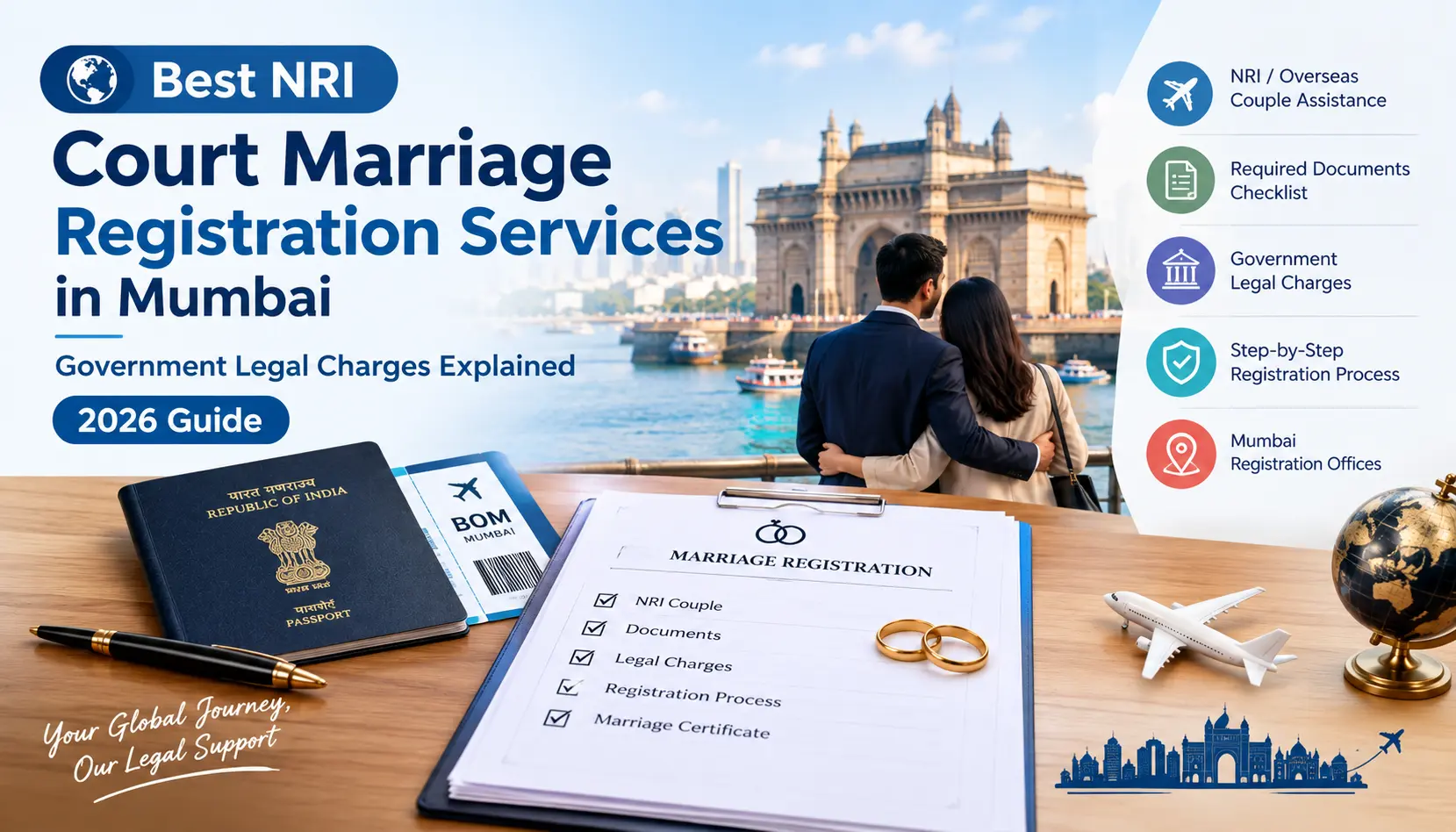
Court marriage procedure in Mumbai is a legal process through which two eligible persons can solemnize their marriage under the Special Marriage Act, 1954. In Maharashtra’s official citizen charter, solemnization under the Special Marriage Act is described as a court marriage.
Unlike a traditional religious wedding, a court marriage under this law does not depend on a particular religious ceremony. The process is handled through the Marriage Officer and includes a statutory notice period, document verification and the presence of three witnesses.
Understanding the process before submitting the notice can help couples prepare the correct documents, identify the appropriate Marriage Officer and avoid confusion about the 30-day notice requirement.
NRI Court Marriage Registration in Mumbai
For an NRI planning to marry in Mumbai, understanding the correct legal route is especially important. NRI court marriage registration in Mumbai can involve additional documentation, residence questions and, in some cases, documents issued outside India.
The first question is not simply “how much does NRI court marriage cost?” It is which marriage process applies to your situation?
A new civil marriage in Mumbai may be solemnized under the Special Marriage Act, 1954. A marriage that has already taken place in another form may require a different registration process. A marriage solemnized outside India can fall under the Foreign Marriage Act, 1969, depending on the circumstances.
This guide explains the main routes, documents, government charges and practical considerations for NRIs and foreign nationals dealing with marriage formalities in Mumbai.
Quick Answer: Can an NRI Have a Court Marriage in Mumbai?
Yes, an NRI can potentially marry in Mumbai under the applicable legal framework, but the normal Special Marriage Act requirements still have to be satisfied.
For a new court marriage under the Special Marriage Act, at least one party must have resided in the relevant district for at least 30 days immediately before giving the notice of intended marriage. The Act also requires a statutory notice period and in-person formalities involving the parties and three witnesses.
Therefore, an NRI who is currently living abroad cannot simply complete a new Mumbai court marriage entirely online or through a representative. The residence, notice and physical-attendance requirements have to be considered before planning the wedding date.
NRI Court Marriage in Mumbai: Which Process Applies?
“NRI marriage registration” can describe several different situations.
NRI Planning a New Court Marriage in Mumbai
If an NRI and another eligible person want to solemnize a new civil marriage in Mumbai, the Special Marriage Act may apply.
NRI Already Married in India
If the marriage has already been solemnized through a Hindu, Muslim, Christian or other applicable ceremony, the couple may need to register that existing marriage under the relevant registration law.
NRI Married Outside India
If the marriage was solemnized abroad, the legal route can be different. The Foreign Marriage Act, 1969 provides a framework concerning marriages of Indian citizens outside India.
This distinction is important because NRI court marriage in Mumbai, NRI marriage registration and registration of a foreign marriage are not automatically the same process.
What Is an NRI Court Marriage?
An NRI court marriage generally refers to a civil marriage involving an Indian citizen living abroad or an eligible foreign-national/NRI couple under an applicable statutory framework.
For a new marriage solemnized in Mumbai under the Special Marriage Act, the Marriage Officer handles the statutory process.
The Maharashtra Department of Registration and Stamps describes solemnization under the Special Marriage Act as court marriage and states that the Marriage Officer issues the marriage certificate after the required procedure is completed.
NRI Court Marriage Procedure in Mumbai
For a new Special Marriage Act marriage, the process broadly follows these stages:
1. Check Eligibility
The parties must satisfy the statutory conditions for solemnization.
The Special Marriage Act includes conditions concerning existing spouses, age, consent and prohibited relationships.
2. Confirm Mumbai Jurisdiction
At least one party must have resided in the relevant district for 30 days immediately before giving the notice.
The Maharashtra Department identifies independent Marriage Officer offices for Mumbai City and Mumbai Suburban.
3. Prepare Documents
The couple should prepare identity, age and residence documents, along with any additional documents required for an NRI or foreign-national case.
4. Submit Notice of Intended Marriage
The prescribed notice is submitted to the Marriage Officer.
5. Complete the Statutory Notice Period
The notice is published and the statutory 30-day period applies before solemnization, subject to the Act’s objection provisions.
6. Attend the Marriage Appointment
The couple and three witnesses attend for the required declaration and solemnization formalities.
7. Obtain the Marriage Certificate
After solemnization, the Marriage Officer enters the marriage certificate in the Marriage Certificate Book as provided by the Act.
Important: NRI Does Not Mean Fully Online
People often search for NRI marriage registration online or NRI court marriage registration online because one partner is living abroad.
Online tools can help with application-related preparation and payments where an official online facility exists. However, they do not automatically remove the statutory in-person requirements.
For example, the Special Marriage Act requires the parties and three witnesses to sign the declaration in the presence of the Marriage Officer.
Maharashtra’s current online marriage-registration system provides online notice/application-related functionality, including online payment, but the applicable statutory procedure still has to be followed.
NRI Court Marriage Documents in Mumbai
The exact NRI court marriage documents depend on the nationality, residence history, marriage route and purpose of the registration.
For a standard Special Marriage Act process, the Maharashtra citizen charter lists:
- Notice in the prescribed format
- Age proof of the bride and groom
- Residence proof of the bride and groom
- Divorce decree, where applicable
- Death certificate of a previous spouse, where applicable
- Identity cards and residential proof of three witnesses
For an NRI or foreign-national case, additional documents may be requested, depending on the circumstances.
These can include documents such as:
- Indian passport, where applicable
- Foreign passport for a foreign national
- Visa or immigration/residence documentation
- Overseas address information
- Proof of marital status or single status, where required
- Divorce or death documents for a previous marriage
- Authenticated or apostilled foreign documents where applicable
- Certified English translations where documents are in another language
The final checklist should be confirmed with the competent Marriage Officer because there is no single additional-document list that applies identically to every NRI or foreign-national case.
Single Status Certificate for NRI or Foreign-National Marriage
A single-status certificate, sometimes described as a bachelorhood or eligibility-to-marry certificate, may be relevant when an authority needs evidence that an applicant is free to marry.
The Ministry of External Affairs states that such a certificate can be issued by a competent court or SDM having jurisdiction over the applicant’s residential address. MEA also describes a process involving counter-attestation by the concerned State Home Department followed by MEA attestation/apostille.
This does not mean that every NRI court-marriage application automatically requires the same certificate. The requirement depends on the case and the authority handling it.
Foreign Documents for NRI Court Marriage in Mumbai
Foreign-issued documents require particular attention.
A document issued outside India may need authentication, apostille, attestation or translation depending on the document and the authority requesting it.
The Ministry of External Affairs states that it provides Apostille for personal documents including marriage certificates, birth/death certificates, affidavits and powers of attorney. For countries that are not members of the Hague Apostille Convention, normal attestation is used instead.
Therefore, an NRI should not wait until the marriage appointment to discover that a foreign document requires additional authentication.
Apostille and Attestation for NRI Marriage Documents
If a marriage certificate or other Indian personal document needs to be used overseas, the requirements of the destination country should be checked.
According to the current MEA information:
- Apostille is used for countries covered by the Hague Convention.
- Normal attestation is used where Apostille is not accepted.
- MEA provides attestation/apostille services through the prescribed process and outsourced service providers.
The current MEA page lists a ₹50 government fee per apostille sticker, along with applicable outsourced service-provider and scanning charges.
These are document-authentication expenses and are separate from the marriage-registration fee.
NRI Marriage Certificate in Mumbai
A marriage certificate is often one of the most important documents for an NRI couple.
It may be required for:
- Spouse visa applications
- Immigration
- Passport-related matters
- OCI-related applications
- Name or marital-status records
- Banking and financial matters
- Insurance
- Employment documentation
- Family sponsorship
- Other government procedures
The receiving authority determines which certificate and authentication format it accepts.
For example, MEA’s OCI guidance states that where a marriage is solemnized in India, a Marriage Certificate issued by the Marriage Registrar is required in the relevant spouse-of-foreign-origin/OCI context. It also addresses apostille/attestation and translation requirements for foreign marriage certificates.
NRI Court Marriage Checklist
Before planning the appointment, make sure you have considered:
☑ Eligibility under the applicable law
☑ Correct Mumbai Marriage Officer jurisdiction
☑ 30-day residence requirement where applicable
☑ Age and identity documents
☑ Residence documents
☑ Three witnesses
☑ Witness identity and address documents
☑ Divorce/death documents, if applicable
☑ Foreign documents, if applicable
☑ Translation/authentication requirements
☑ Travel plans for the couple and witnesses
☑ Overseas certificate requirements after registration
Frequently Asked Questions
NRI Court Marriage Registration in Mumbai: Plan Beyond the Wedding Date
For an NRI, the most important part of marriage registration is often preparation before arriving in Mumbai.
Understanding the correct legal route, satisfying jurisdiction and residence requirements, preparing Indian and foreign documents, arranging three witnesses and checking whether the final marriage certificate needs apostille or attestation can make the process much easier to plan.
Our team provides NRI court marriage registration assistance in Mumbai, including document guidance, application preparation, witness guidance and certificate-related support.
Contact us to discuss your NRI marriage requirements and the applicable legal process in Mumbai.