Our Popular Services
- Court Marriage Registration in Mumbai
- Hindu Marriage Registration in Mumbai
- Temple Marriage Registration in Mumbai
- Muslim Marriage Registration in Mumbai
- Nikah Nama Muslim Marriage Certificate Mumbai
- Christian Marriage Registration in Mumbai
- Catholic Marriage Registration in Mumbai
- Online Marriage Registration in Mumbai
- Urgent Marriage Registration in Mumbai
- NRI or Foreigner Marriage Registration in Mumbai
- Marriage Registration Under Special Marriage Act
- Notary Services
Special Marriage In Mumbai – Process, Eligibility And Documents
Special Marriage Act registration Mumbai provides eligible couples with a civil procedure to solemnize their marriage under the Special Marriage Act, 1954, without requiring a religious ceremony. The Act also provides a separate procedure for registering certain marriages already celebrated in another form.
This guide to Special Marriage Act registration in Mumbai explains both procedures, including eligibility conditions, residence requirements, required documents, online application options, the statutory notice period and witness formalities.
Couples should identify the correct procedure before applying because the eligibility conditions and documentation requirements for a new civil marriage are different from those for registration of an existing marriage.
Advocate Pradeep Kumar Pandey provides guidance on document preparation, application formalities, eligibility requirements and the procedures followed by the concerned Marriage Officer.
Couples considering a civil marriage under the Special Marriage Act, 1954, can also explore our main Court Marriage Services in Mumbai page for an overview of the available assistance, eligibility requirements, documentation guidance and marriage solemnisation formalities.
For information about the Mumbai City Marriage Office and the Old Custom House location in Fort, read our guide to Old custom house marriage registration.
Special Marriage Act – Quick Answer
The Special Marriage Act, 1954 allows eligible couples to marry through a civil procedure before a Marriage Officer, without requiring a religious marriage ceremony.
For a new civil marriage, at least one party must have resided in the concerned district for 30 days immediately before submitting the notice. The Act also provides a 30-day statutory notice period, during which objections may be raised only on legally permitted grounds.
The Act separately allows registration of certain marriages already celebrated in another form under Chapter III, subject to additional eligibility and procedural requirements.
Important: The procedure, documents and eligibility conditions differ between a new civil marriage and registration of an existing marriage.
What Is the Special Marriage Act, 1954?
The Special Marriage Act, 1954 is an Indian law that provides a civil marriage procedure for eligible couples, irrespective of their religion or caste. It also provides a separate procedure for registering certain marriages already celebrated through other forms.
The Act covers important legal requirements, including:
- Eligibility and age requirements
- Notice of intended marriage
- Residence and jurisdiction requirements
- Objections on legally permitted grounds
- Marriage solemnization and three witnesses
- Issuance of the marriage certificate
- Registration of certain existing marriages under Chapter III
Important: A new civil marriage under the Act and registration of an already celebrated marriage follow different statutory provisions.
Special Marriage Act in Maharashtra
The Special Marriage Act, 1954 applies in Maharashtra, including Mumbai and Navi Mumbai. The legal procedure is governed by the Act and the applicable Maharashtra Special Marriage Rules, 1964.
The Maharashtra Department of Registration and Stamps provides official information relating to Special Marriage Act procedures and Marriage Officers.
Important legal references include:
- Special Marriage Act, 1954
- Maharashtra Special Marriage Rules, 1964
- Official application and notice requirements
- Jurisdiction and document requirements of the concerned Marriage Officer
Couples should confirm the applicable procedure with the competent Marriage Officer before submitting their application.
Who Can Marry Under the Special Marriage Act?
For a new civil marriage under the Special Marriage Act, 1954, both parties must meet the eligibility conditions specified under Section 4 of the Act.
The main eligibility requirements include:
- Marital status: Neither party should have a living spouse at the time of marriage.
- Age: The male must have completed 21 years and the female must have completed 18 years, as specified in the Act.
- Consent and mental capacity: Both parties must satisfy the consent and mental-capacity requirements under Section 4.
- Prohibited relationships: The parties must not fall within prohibited degrees of relationship, except where an applicable custom is permitted under the Act.
- Residence for notice: At least one party must have resided in the concerned district for at least 30 days immediately before submitting the notice of intended marriage.
Important Difference for Registration of an Existing Marriage
Chapter III of the Special Marriage Act provides a separate procedure for registering certain marriages already celebrated in another form.
Under Section 15, both parties must have completed 21 years at the time of registration, along with satisfying the other applicable statutory conditions.
Important: Eligibility for a new civil marriage and registration of an existing marriage is not identical. Couples should confirm the appropriate legal procedure before applying.
Special Marriage Act Registration in Mumbai
The Special Marriage Act, 1954 provides two different legal routes for eligible couples in Mumbai.
1. Civil Marriage Under the Special Marriage Act
Couples planning a new civil marriage may follow the solemnization procedure under Chapter II of the Act.
This generally involves submitting a notice of intended marriage, completing the statutory notice period, verifying eligibility and solemnizing the marriage before the Marriage Officer with three witnesses.
2. Registration of an Already Solemnized Marriage
Couples who have already completed a marriage ceremony in another form may be eligible for registration under Chapter III of the Special Marriage Act.
This procedure has separate conditions under Section 15 and registration formalities under Section 16, including requirements relating to age, residence and the existing marriage.
Important: These two routes have different eligibility conditions and procedures. Couples should identify the correct route before submitting an application.
Special Marriage Act Procedure in Mumbai
The Special Marriage Act procedure in Mumbai depends on whether a couple is planning a new civil marriage or registering an existing marriage.
For a new civil marriage under Chapter II of the Special Marriage Act, 1954, the procedure generally includes the following steps.
Step 1: Check Marriage Eligibility
Both parties must satisfy the applicable conditions under Section 4, including age, marital status, consent and prohibited-relationship requirements.
Step 2: Identify the Correct Marriage Officer
At least one party must have resided in the concerned district for a minimum of 30 days immediately before submitting the notice of intended marriage.
Step 3: Submit Notice of Intended Marriage
Submit the prescribed written notice to the competent Marriage Officer. The notice is recorded and published according to the applicable statutory procedure.
Step 4: Complete the Statutory Notice Period
The Act provides a 30-day objection period following publication of the notice. Objections can be raised only on the legally permitted grounds.
Step 5: Complete Declaration and Witness Formalities
Before solemnization, both parties and three witnesses must sign the prescribed declaration in the presence of the Marriage Officer.
Step 6: Solemnization and Marriage Certificate
After the applicable statutory conditions are satisfied, the marriage is solemnized. The Marriage Officer enters the certificate in the Marriage Certificate Book, which is signed by the couple and three witnesses.
Important: These steps describe a new civil marriage under Chapter II. Registration of a marriage already celebrated in another form follows a separate procedure under Chapter III of the Act.

Registration of Marriage Under Special Marriage Act
The Special Marriage Act, 1954 also allows certain marriages already celebrated in another form to be registered under Chapter III, subject to the conditions specified in Section 15.
Eligibility for Registration of an Existing Marriage
The main statutory conditions include:
- Marriage ceremony: A marriage ceremony must have been performed, and the parties must have been living together as husband and wife since that ceremony.
- Marital status: Neither party should have more than one spouse living at the time of registration.
- Age: Both parties must have completed 21 years at the time of registration.
- Prohibited relationships: The parties must satisfy the applicable restrictions on prohibited degrees of relationship.
- Residence: Both parties must have resided within the concerned Marriage Officer’s district for at least 30 days immediately before applying.
Registration Procedure Under Section 16
The couple must submit the prescribed application to the competent Marriage Officer. The authority then follows the applicable notice, verification and objection procedures before deciding whether the marriage can be registered.
Important: Registration under Chapter III is different from solemnizing a new civil marriage under Chapter II. Couples should confirm eligibility and document requirements before submitting their application.
Special Marriage Act Documents Required
The Special Marriage Act documents required can vary depending on whether the couple is seeking solemnization under the Act or registration of a marriage already celebrated.
For solemnization under the Act, the Maharashtra government’s citizen charter lists:
- Notice in the prescribed format
- Proof of age
- Proof of residence
- Divorce decree, where applicable
- Death certificate of a previous spouse, where applicable
- Identity cards and residential proof of three witnesses
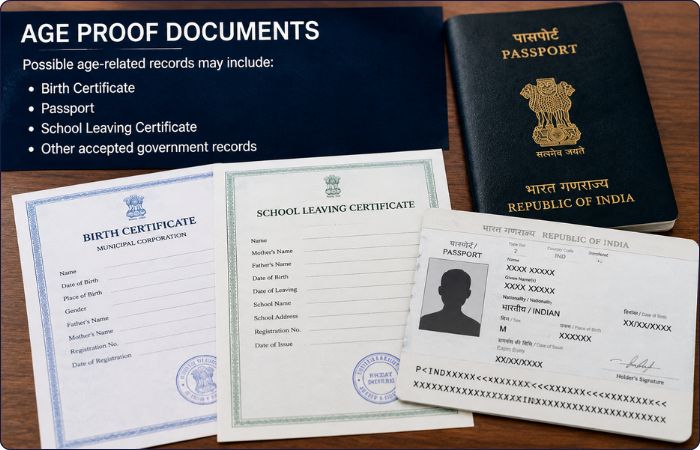
Common Age-Proof Documents
Depending on the authority’s accepted list, examples may include:
- Birth Certificate
- School Leaving Certificate
- Passport
- SSC/HSC Certificate
- Other accepted age records
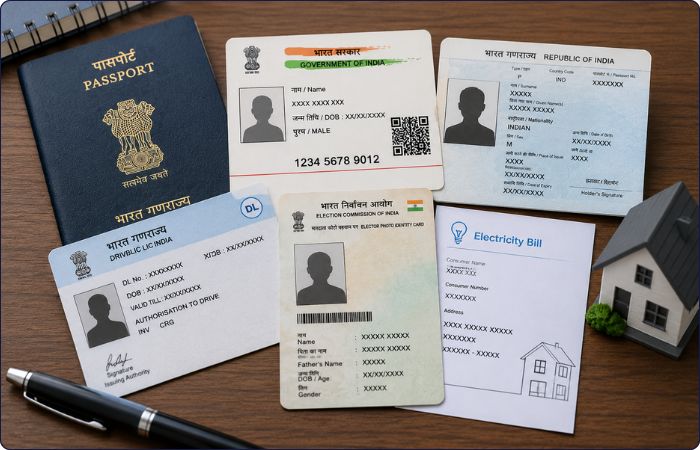
Residence Documents
Common examples may include:
- Aadhaar Card
- Passport
- Voter/Election Card
- Electricity Bill
- Telephone Bill
- Leave and Licence or other accepted residence proof
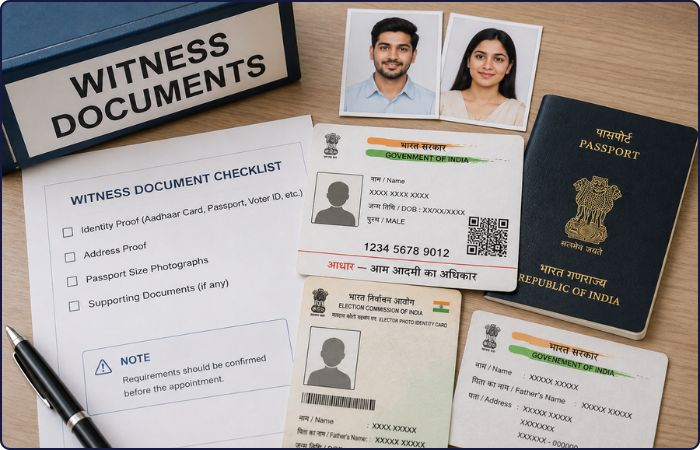
Witness Documents
The Maharashtra citizen charter specifically refers to identity cards and residential proof of three witnesses for solemnization under the Special Marriage Act.
Documents for Special Circumstances
Additional documents may be required where:
- One party is divorced
- One party is widowed
- A foreign national is involved
- There has been a change of name
- Additional residence or nationality evidence is required
Important: No single checklist should be treated as universal. Confirm the final documents with the concerned Marriage Officer before submission.
Special Marriage Act Registration Online
Couples in Mumbai can initiate certain application formalities under the Special Marriage Act, 1954 through the online services provided by the Maharashtra Department of Registration and Stamps, where available.
The Maharashtra Government provides online service access for marriage-related procedures under the Special Marriage Act, 1954. The available services include solemnization of a new civil marriage and registration of certain marriages already celebrated in another form. These are separate application processes, so couples should select the appropriate service after checking their eligibility and jurisdiction.
Applicants can refer to the official Maharashtra Aaple Sarkar Services portal for current service details and application access.
Online submission does not mean that the complete marriage procedure can be completed remotely. Applicable document verification, personal attendance, statutory notice and witness requirements must still be fulfilled.
Online application facilities may be available for both a proposed civil marriage and registration of certain marriages already celebrated in another form. These follow different legal procedures.
Can the Entire Special Marriage Act Process Be Completed Online?
No. Submitting an application or notice online does not mean the complete marriage procedure can be finished remotely.
Couples must complete the applicable statutory requirements before the competent Marriage Officer, including document verification, personal attendance and witness formalities.
Before Applying Online
Confirm the following:
- Whether you are planning a new civil marriage or registering an existing marriage
- Eligibility under the applicable provisions
- Correct Marriage Officer and jurisdiction
- Required identity, age and residence documents
- Applicable notice and witness requirements
- Availability of the relevant government online service
Important: Online application does not bypass the statutory notice period or guarantee immediate marriage registration or certificate issuance.
Special Marriage Act Notice Period
Under the Special Marriage Act, 1954, couples planning a new civil marriage must submit a notice of intended marriage to the competent Marriage Officer.
According to Section 5, at least one party must have resided in the concerned district for 30 days immediately before submitting the notice.
Is the 30-Day Notice Period Mandatory?
Under Section 7, objections to the intended marriage may be raised within 30 days after publication of the notice, but only on the legal grounds specified in Section 4.
If the statutory requirements are satisfied and no valid objection prevents solemnization, the marriage may proceed after the prescribed period.
Can Couples Get Married on the Same Day?
A standard new civil marriage under the Special Marriage Act cannot bypass the statutory notice requirements. Having all documents ready does not automatically make the marriage eligible for same-day solemnization.
Important: The 30-day residence requirement before giving notice and the 30-day notice period are separate legal requirements. Couples should check their eligibility and timelines with the competent Marriage Officer before applying.
Three Witnesses for Special Marriage Act
For a new civil marriage under the Special Marriage Act, 1954, three witnesses are required.
Under Section 11, both parties and three witnesses must sign the prescribed declaration in the presence of the Marriage Officer. After solemnization, the marriage certificate is also signed by the couple and three witnesses under Section 13.
Who Can Be a Witness?
Witnesses should be capable of understanding and witnessing the marriage formalities. The concerned Marriage Officer may require identity and residential address documents for verification.
Documents Witnesses May Need
- Valid identity proof
- Residential address proof
- Photographs or other documents, where prescribed
Important: The three-witness requirement described here applies to solemnization of a new marriage under the Special Marriage Act. Requirements for other marriage-registration procedures should be checked separately with the competent authority.
Special Marriage Act Certificate
A Special Marriage Act certificate is an official marriage record entered by the competent Marriage Officer after a marriage is solemnized under the Special Marriage Act, 1954.
Under Section 13, the Marriage Officer enters the certificate in the Marriage Certificate Book. The certificate is signed by both parties and three witnesses.
Is the Special Marriage Act Certificate Legally Valid?
Yes. Under Section 13, the certificate entered in the Marriage Certificate Book is conclusive evidence that a marriage under the Act has been solemnized and that the required witness-signature formalities have been completed.
The Act also provides a separate certificate procedure for eligible marriages registered under Chapter III after being celebrated in another form. For general certificate applications and documentation, read our guide to marriage certificate assistance in Mumbai.
Important: A Special Marriage Act certificate is issued by the competent Marriage Officer after completion of the applicable statutory formalities. Private agents or notaries cannot independently issue this government certificate.
Court Marriage Under Special Marriage Act
The term court marriage under the Special Marriage Act commonly refers to a civil marriage solemnized before a Marriage Officer under the Special Marriage Act, 1954.
For more information about the application process, documents and legal requirements, explore our court marriage services in Mumbai.
Unlike a religious marriage ceremony, this procedure allows eligible couples to marry through a civil process without requiring a religious ceremony.
Is Court Marriage Conducted Inside a Court?
Not necessarily. A marriage under the Special Marriage Act is solemnized before the competent Marriage Officer, not necessarily inside a courtroom.
Under Section 12, the marriage may be solemnized at the Marriage Officer’s office or another permitted location, subject to the applicable statutory conditions and prescribed arrangements.
Who Can Choose This Procedure?
Eligible couples may include:
- Interfaith couples
- Inter-caste couples
- Couples who prefer a civil marriage
- Couples who wish to marry without a religious ceremony
Important: Eligibility, residence requirements, the statutory notice period and three-witness formalities must be satisfied before a new civil marriage can be solemnized under the Act.
Special Marriage Act Lawyer in Mumbai
Couples planning a civil marriage under the Special Marriage Act, 1954 may seek professional legal assistance to understand eligibility, documentation, statutory notice requirements and the procedure before the competent Marriage Officer.
At Court Marriage & Notary Services, Advocate Pradeep Kumar Pandey provides legal guidance and documentation assistance for eligible couples in Mumbai and Navi Mumbai.
How We Can Assist You
- Eligibility Guidance: Understanding the applicable marriage conditions and legal requirements.
- Document Preparation: Checking age, identity, residence and supporting documents.
- Notice Application Guidance: Assistance with the prescribed notice and application formalities.
- Witness Requirements: Guidance on arranging the required documents for three witnesses.
- Appointment Guidance: Understanding the relevant Marriage Officer’s procedures.
- Special Cases: Assistance with documentation for interfaith couples, divorcees, widows or widowers, NRIs and foreign nationals.
Local Assistance in Mumbai
Our team provides guidance through offices in Bandra East, Mumbai depending on the couple’s requirements.
Important: Marriage approval, solemnization and certificate issuance are handled by the competent Marriage Officer. Professional assistance does not replace statutory requirements or guarantee a particular outcome.
Special Marriage Act Fees
The Special Marriage Act registration fees in Mumbai depend on the applicable legal procedure, government authority and required formalities.
Government Marriage Registration Charges
Government charges may include:
- Notice of intended marriage fees
- Marriage solemnization or registration fees
- Marriage certificate-related charges
- Additional official charges, where applicable
The exact fees should be confirmed with the competent Marriage Officer or the Maharashtra Department of Registration and Stamps before applying.
Professional Legal Assistance Fees
Couples may choose professional assistance for document checking, application preparation, notice-related guidance and appointment formalities.
Professional legal assistance charges are separate from government fees and depend on the services required.
Important: Government fees and professional charges should be clearly explained separately. Paying additional service charges does not remove statutory requirements or guarantee faster marriage solemnization or certificate issuance.
Special Marriage Act Requirements for Interfaith Couples
The Special Marriage Act, 1954 provides a civil marriage procedure for eligible couples from different religions who wish to marry without undergoing religious conversion.
Can Interfaith Couples Marry Under the Special Marriage Act?
Yes. Eligible interfaith couples can marry under the Act without either person needing to change their religion solely for the civil marriage.
The applicable requirements include:
- Meeting the legal age and eligibility conditions under Section 4
- Satisfying the relevant residence and jurisdiction requirements
- Submitting the prescribed notice of intended marriage
- Completing the statutory notice and objection period
- Completing solemnization formalities with three witnesses
Is Parental Consent Required?
The Special Marriage Act does not generally require parental consent when both parties are adults who meet its legal eligibility and consent requirements.
Important: The procedure must be completed before the competent Marriage Officer. A marriage under the Special Marriage Act cannot bypass applicable statutory requirements merely because the couple belongs to different religions.
Is Special Marriage Act the Same as Marriage Registration?
No, they are not exactly the same. The Special Marriage Act, 1954 is a law that provides procedures for civil marriage and registration of certain marriages already celebrated in another form.
Civil Marriage Under the Special Marriage Act
Couples planning a new civil marriage may follow the solemnization procedure under Chapter II of the Act. This involves the applicable notice period, eligibility verification and marriage formalities before a Marriage Officer.
Registration of an Already Solemnized Marriage
Couples who have completed a legally valid marriage ceremony may be able to follow the applicable marriage registration process in Mumbai to officially record their marriage.
Chapter III of the Special Marriage Act also provides a specific route for registering certain marriages celebrated in other forms, subject to its statutory conditions.
Which Procedure Should Couples Choose?
The appropriate procedure depends on whether the marriage has already taken place, the applicable legal requirements and the couple’s circumstances.
Important: Couples should identify the correct procedure before preparing documents or submitting an application.
Frequently Asked Questions About Special Marriage Act
Need Help With Special Marriage Act Registration in Mumbai?
Planning a civil marriage under the Special Marriage Act, 1954, or need assistance with registration of an already solemnized marriage?
Court Marriage & Notary Services provides professional guidance on eligibility, document preparation, statutory notice requirements, witness documentation and application formalities.
With guidance from Advocate Pradeep Kumar Pandey, our team assists eligible couples through our offices in Bandra East, Mumbai.
Contact us to understand the appropriate legal procedure and next steps for your marriage registration requirements.